
TLDR: Deep Work is a practical case for why the ability to focus without distraction is the most valuable skill you can build right now, and a roadmap for actually doing it.
- Title: Deep Work: Rules for Focused Success in a Distracted World
- Author: Cal Newport
- Format Consumed: Audiobook
- Length: ~8 hours
- Genre: Productivity / Professional Development
- Rating: ⭐⭐⭐⭐⭐
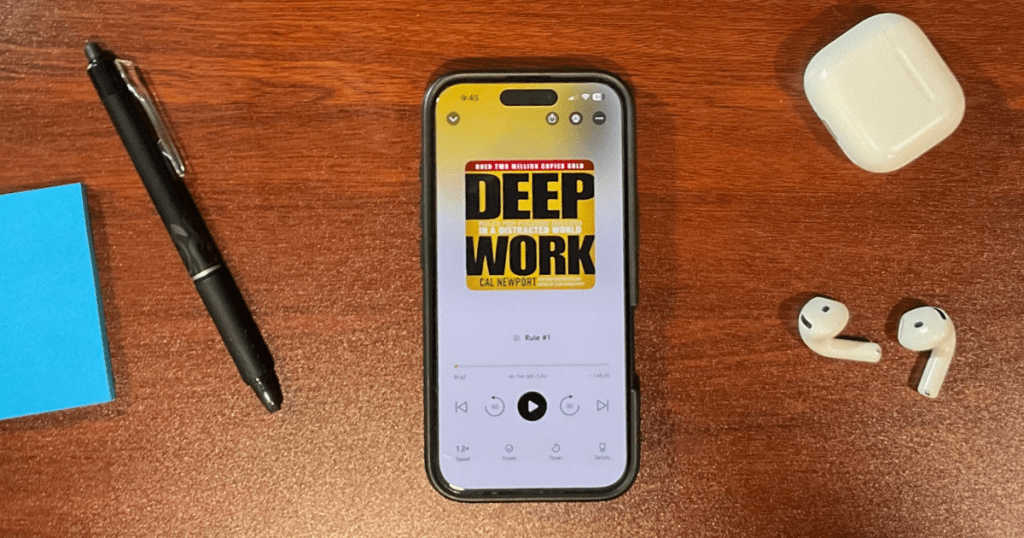
I picked this one up because I’ve been thinking a lot about where my career is headed. Right now my work doesn’t demand a whole lot of deep, sustained focus. It’s fine. But I know that’s going to change, and I wanted to get ahead of it. Deep Work had been sitting on my list for a while and the audiobook was the push I needed to finally get through it.
The core problem Newport is addressing is one most of us feel but don’t have language for: we’re constantly available, constantly distracted, and constantly busy, but we’re not actually producing anything that matters. Shallow work (emails, meetings, reactive tasks) fills the day while the high-value, cognitively demanding stuff gets squeezed into whatever time is left, which is usually nothing.
Newport’s argument is that the ability to do deep work, to focus without distraction on cognitively demanding tasks, is both increasingly rare and increasingly valuable. His approach is part philosophical, part tactical. He builds the case for why it matters, then gives you concrete frameworks for building the habit.
This book is best suited for knowledge workers who feel like they’re always busy but never making real progress on the things that actually move the needle.
The Lowdown on Deep Work
The book is split into two parts: the case for deep work, and the rules for doing it. Part one makes the argument that depth is the differentiator in the modern economy, leaning on examples from academia, business, and creative fields. Part two is where it gets practical, with four rules: work deeply, embrace boredom, quit social media (or at least be intentional about it), and drain the shallows.
Newport backs his claims with research, examples, and a lot of anecdotes from his own career as a computer science professor. Compared to something like Indistractable by Nir Eyal, which focuses more on the psychology of distraction, this one is more prescriptive about how you structure your work life. It’s less about why you check your phone and more about how to build a professional life where focus is the default.
The writing is clear and well-paced. Newport doesn’t over-explain, and the audiobook format holds up well across both parts. The structure is clean enough that you can take notes mentally and not feel like you missed anything.
How Easy Is This to Get Through?
Pretty easy. Eight hours on audio went by faster than expected. Newport narrates it himself and he’s a competent narrator. Nothing flashy, just clear and steady. I got through most of it during runs and commutes, which is my usual test for whether an audiobook holds attention. This one passed.
Fair warning: the first half of the book is heavier on examples from academia. Newport spends a fair amount of time in his own world, like writing papers, pursuing publication, and optimizing his professor schedule. If you’re not in that world, some of it requires a bit of translation. It’s not a dealbreaker, but there’s some eye-rolling to be done before the more universally applicable stuff kicks in.
My 4 Biggest Takeaways From Deep Work
1. If you don’t produce, nothing else matters.
This one hit. Newport makes it clear early that talent and skill are table stakes. What separates people who thrive is output. You can be the smartest person in the room and still lose to someone who can sit down and actually produce something. That’s a useful thing to hear when you’re busy convincing yourself that staying on top of Slack counts as work.
If you don’t produce, you won’t thrive — no matter how skilled or talented you are.
2. What you focus on is who you become.
Newport goes somewhere more philosophical here than I expected. Attention isn’t just a productivity tool. It’s the thing that shapes your inner life. The work you give your focus to becomes the lens through which you experience your days. That reframe made me think about how I spend time outside of work too, not just during it.
Who you are, what you think, feel, and do, what you love — is the sum of what you focus on.
3. Two skills. That’s it.
Newport boils it down to two things: the ability to quickly master hard things, and the ability to produce at an elite level in terms of both quality and speed. Both require deep work. Neither happens by accident. As a developer who’s constantly learning new tools and frameworks, this one felt directly applicable. You can’t half-pay-attention your way through picking up a skill that actually matters.
Two Core Abilities for Thriving in the New Economy: 1. The ability to quickly master hard things. 2. The ability to produce at an elite level, in terms of both quality and speed.
4. Your evenings matter more than you think.
Newport makes a case for protecting your off-hours as recovery time for your attention, not as extra work time. Checking email after dinner isn’t a small thing. It’s pulling from the same cognitive resource you need to do focused work the next day. For someone who trains for marathons, this clicked immediately. You don’t schedule a hard workout the night before a long run. Same logic applies here.
If you keep interrupting your evening to check and respond to email… you’re robbing your directed attention centers of the uninterrupted rest they need for restoration.
Final Thoughts
Newport dwells a little too long in his academic world for my taste, and there are moments where the book reads like it was written for someone whose biggest professional challenge is getting tenure. Look past that. The core ideas are solid, the rules are actionable, and the argument for why this skill matters only gets stronger the more you look at how most people actually spend their working hours.
If you’re in a role where focused work matters, or you know you’re heading toward one, read this. If you’re a developer, a writer, or anyone who builds things that require real cognitive output, it’s worth every one of those eight hours. Start training for depth before you need it. That’s the whole point.