TLDR: Your body is still running caveman hardware in a modern world, and that mismatch is why so many of us feel tired, anxious, and off. The Caveman Method is a simple framework built around three pillars — hunting (move hard, train with others, build things), sleeping (align with the sun, protect your environment), and connection (build real relationships and a tribe). Get those three things right, and most of the physical and mental health stuff takes care of itself.

Let me tell you something that took me an embarrassingly long time to figure out: we are cavemen wearing business casual.
Our bodies haven’t changed. The hardware is the same. What’s changed is the software, the world we built around ourselves, and it is deeply incompatible with the machine running underneath it. We stopped evolving long before we invented cubicles, smartphones, and DoorDash. And yet here we are, wondering why we’re tired, anxious, and soft.
The fix, I’d argue, is stupidly simple. Stop trying to optimize your way to health with biohacking protocols and $80 supplements and start doing what your ancestors were built to do. I call it the Caveman Method.
A Small Disclaimer Before You Keep Reading
I have done exactly zero research on actual cavemen. When I say “caveman,” I mean it loosely. I’m referring to the version of humanity that existed before the modern world made everything convenient and, consequently, terrible for us. Think pre-agriculture, pre-industrialization, pre-Netflix.
Everything in this post comes from testing it on myself. I’m a marathon runner, a gym regular, a hockey and rugby player, and a dad of three. I’ve experimented with a lot of this stuff and found it works for me. Because of that, this is written from a man’s perspective, I can’t speak to the cavewoman experience, but I’d bet a lot of it translates.
Take what’s useful. Leave the rest.
The Caveman’s Day: Three Things
Cavemen only cared about three things: hunting, sleeping, and fucking. That’s it. No career ladders. No inbox zero. No existential dread about the news cycle. Just those three things, executed daily, on repeat.
Modern life has convinced us that complexity is sophistication. It’s not. Let’s break down each pillar and figure out what our version of it looks like today.
Pillar One: The Hunt
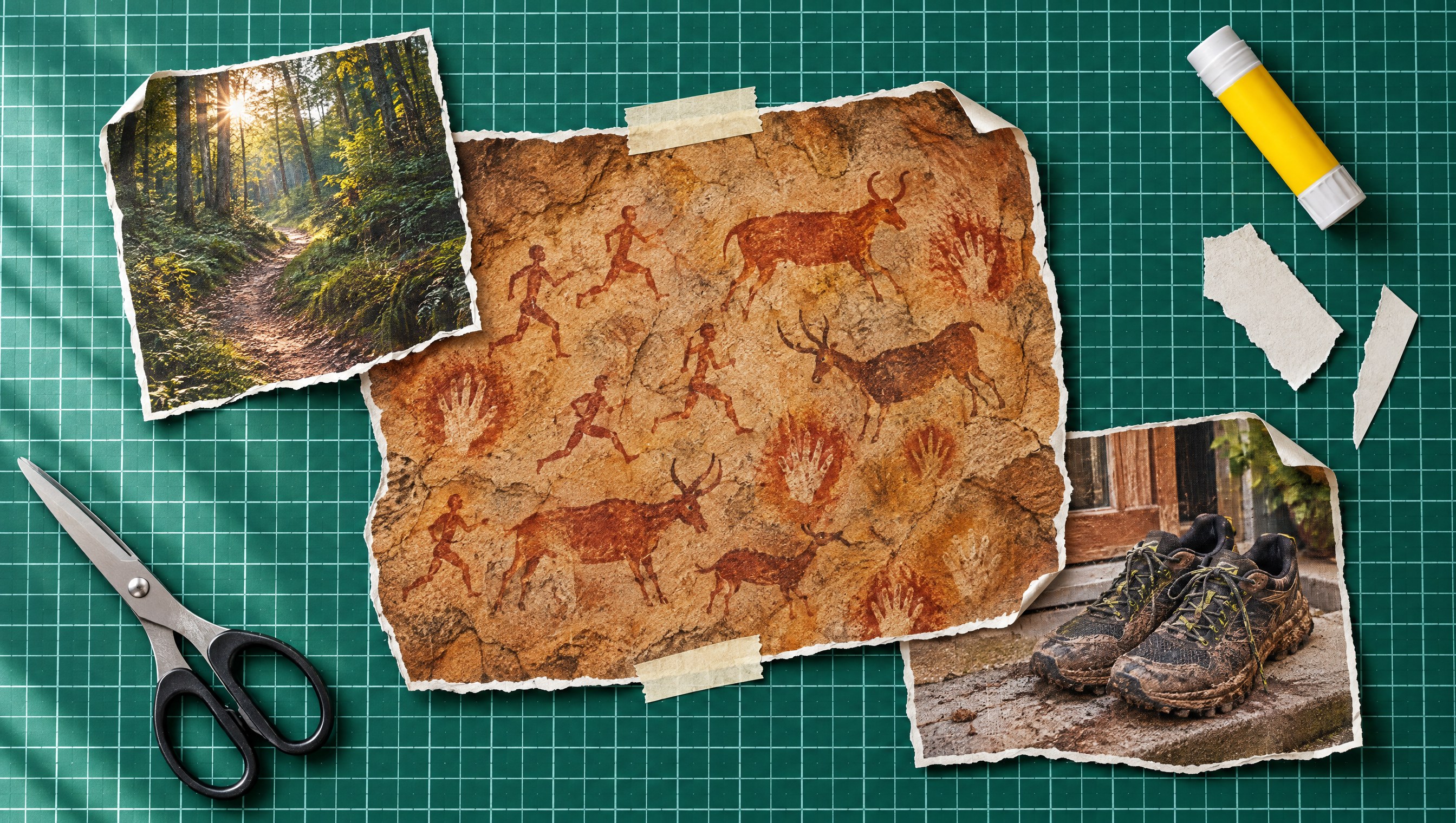
Hunting wasn’t just cardio. It was a full-day physical and social event. Cavemen walked miles to find prey, sprinted to chase it, wrestled it to the ground, killed it, and then hauled it back to camp. They did this in groups, using tools they built with their own hands, communicating and coordinating the whole time.
Hunting was, essentially, a team CrossFit session with life-or-death stakes and a charcuterie board at the end.
When you break it down, the hunt covered:
- Long, frequent walks — scouting, traveling, carrying
- High-intensity cardio bursts — the chase
- Physical strength and combat — the kill
- Teamwork toward a shared goal — the social element
- Building and using tools — problem solving with your hands
Your modern checklist to simulate the hunt:
- Daily walks (before and after meals, at minimum)
- 30+ minutes of intense cardio multiple times per week
- Strength training at least three days a week
- A team sport or group fitness activity regularly
- A hands-on creative or productive hobby
If your weekly routine hits all five of these, you’re hunting. We’ll get into specific hobbies later.
Pillar Two: Sleep
There wasn’t a lot to do after dark when you’re a caveman. You can’t see anything, predators are out, and there’s no Instagram to scroll. So they slept. A lot. And they slept aligned with the sun. Down when it got dark. Up when it got light. No alarm clock. No melatonin gummy. Just the rhythm of the planet.
But sleep wasn’t passive. It required preparation. They built shelters. They kept fires. They kept watch against threats. Sleep was something they earned through physical output and protected through their environment.
- Sleep when the sun goes down (or close to it)
- Wake when the sun comes up
- Build and protect your “shelter” — your sleep environment matters
- Earn your sleep through physical exertion
The modern saboteur here is light. Specifically, the blue light coming off every screen in your house at 10pm. Cavemen had firelight at night, which is warm-toned and doesn’t suppress melatonin. Your phone does. The closer your evening light environment mimics firelight (warm, dim, and eventually dark ) the easier sleep becomes.
Consistency beats duration. Sleeping eight hours at random times is worse than sleeping seven hours at the same time every night. Your body wants rhythm. Give it rhythm.
Pillar Three: Connection (Yes, I’m Being Classy About It)
Look, cavemen weren’t celibate. They found mates, built bonds, raised kids, and maintained relationships within their tribe. Physical intimacy was part of life, but so was the broader social fabric. Loyalty, belonging, trust.
The research on loneliness is genuinely alarming. Social isolation raises your risk of early death by something like 29%. Your brain treats chronic loneliness as a survival threat because for cavemen, it was. An isolated caveman was a dead caveman.
Your body needs human connection the same way it needs food and sleep. This isn’t soft. This is biology.
- Prioritize your romantic relationship — make time for your partner, not just time in the same room
- Build and maintain friendships with people you do physical things with
- Have a tribe — a group with shared goals, whether that’s a running club, a rec hockey team, or a lifting crew
- Put the phone down and be actually present with the people around you

Mental Health: The Part Nobody Talks About Honestly
Cavemen didn’t have anxiety disorders. Well… they might have, but anxiety had a clear purpose back then. It kept you alive. You felt stress, your body flooded with cortisol and adrenaline, you ran or you fought, the threat resolved, and you recovered.
Today, we have the same stress response but the stressors are chronic and largely invisible. An aggressive email. A bad commute. Financial worry. Your brain treats these the same way it treated “tiger in the bushes”. Except you can’t run from your mortgage. You just sit with the cortisol, day after day, and wonder why you feel terrible.
Exercise is the original stress relief. Not because it distracts you but because it literally completes the stress cycle. Your body was designed to respond to stress by moving. When you lift, run, or play a sport, you’re giving your nervous system the resolution it’s been waiting for.
A few other things your caveman brain needs that modern life has stripped away:
Sunlight. Morning light exposure sets your circadian rhythm, boosts serotonin, and helps regulate your sleep. Cavemen got this automatically. You have to seek it out. Walk outside in the morning. Even on cloudy days, outdoor light is dramatically brighter than indoor light.
Real rest. Cavemen didn’t hustle culture themselves to death. Downtime was actual downtime. Sitting around a fire, not half-watching TV while doomscrolling on your phone. Your brain needs genuine rest to process, consolidate, and recover. Boredom isn’t a problem to solve. It’s a feature.
Purpose through making things. There’s real, documented psychological benefit to creating something with your hands. Cavemen built tools and shelters. tangible things that meant survival. Your version of this might be woodworking, gardening, cooking a meal from scratch, or playing guitar. The medium doesn’t matter. The making does.
A tribe with shared stakes. Depression and anxiety thrive in isolation. They struggle in community. The team sport isn’t just cardio, it’s belonging. The group run isn’t just training, it’s accountability and connection. Stack your physical activities to also be social ones and you’re hitting mental health benefits without even trying.
The Caveman Year: Diet and Weight
Let’s zoom out from the day and look at the year, because cavemen didn’t eat the same way in January as they did in July.
Diet
Caveman food was simple: meat, fish, eggs, vegetables, fruits, and nuts. Nothing processed. Nothing that came in a crinkly bag. High protein, whole foods, as close to the source as possible.
I’m not saying you need to go full paleo and never eat a slice of pizza again. I certainly don’t. But the 90/10 principle works well here. If 90% of your diet is whole foods (lean meats, salads, vegetables, fruits) your body handles the other 10% just fine.
Avoid, or at least limit: bread, pasta, baked goods, anything where the ingredient list looks like a chemistry textbook. Your gut knows the difference.
Seasonal Weight Management
This is the piece that I think is genuinely underrated, and it’s also the most obvious thing in the world when you think about it.
Cavemen had a natural cut and bulk cycle. It wasn’t planned. It was just reality:
- Winter — food was scarce. Natural calorie deficit. Your body got lean.
- Summer — food was abundant. Natural calorie surplus. Your body built reserves.
- Spring and Fall — food was average. Maintenance.
That’s a four-month rotation: cut, maintenance, bulk, maintenance, repeat.
Most people in the gym world treat cutting and bulking like arbitrary choices based on aesthetic goals. The caveman approach reframes it as something your body already expects. Because it does. Eating in a slight deficit from roughly November through February, then gradually increasing through summer, isn’t some bro-science experiment. It’s just seasonal eating.
Hobbies by Type
Here’s where theory meets practice. Below are the categories of activity that, taken together, simulate a caveman’s full life. You don’t need all of them at once. But you should have at least one in each category.
Cardio
Simulates the chase. Running, swimming, and cycling are the obvious ones. Rowing is underrated. The goal is sustained elevated heart rate for at least 30 minutes, multiple times per week. If you’re a runner, you already have this. But mix it up. Monotony kills motivation.
Daily Walks
This one is non-negotiable and wildly underestimated. Walk before and after meals if you can. Even just 10-15 minutes. Walk in the morning. Walk at lunch. The caveman didn’t sit at a desk for eight hours. They moved constantly at low intensity. Walking manages blood sugar, supports digestion, clears your head, and is almost comically good for you relative to how little effort it requires.
Aim for a mile or more each walk. Multiple times a day if you can swing it.
Strength Training
At least three days a week in the gym. Five is better. Cavemen used their bodies physically every single day (hauling, building, fighting). The gym is a compressed, targeted version of that. You don’t need to do it daily because the intensity is higher, but you do need to do it consistently.
Compound movements, like deadlifts, squats, presses, and rows, should be your foundation. They simulate real-world physical demands better than isolation work.
Team Sport
Once or twice a week, do something physical with other people toward a shared goal. Hockey, rugby, soccer, basketball, volleyball. Doesn’t matter. This is the social hunt. It checks physical fitness, connection, competition, and belonging all in one shot. If you’re not in a league, find one. This one’s worth the scheduling hassle.
Date Nights and Intentional Connection
Whether you’re in a relationship or not, you need to be making and maintaining real connections. If you have a partner, schedule it. Literally put it on the calendar. If you’re single, this means actually showing up for friends, going on dates, being present with people you care about.
Passive coexistence with people isn’t connection. Cavemen didn’t grunt at each other from across the cave and call it bonding.
Creative Hobby
Do something with your hands that produces something. This simulates tool-making. Music, painting, woodworking, drawing, writing. It should be creative and it should result in an output you can point to. This feeds a part of your brain that modern life consistently starves.
Productive Hobby
Do something with your hands that is useful. Gardening, home improvement, knitting, cooking elaborate meals, building furniture. The distinction from creative hobbies is utility. You’re making something that serves a practical purpose. Both matter. Both scratch different parts of the caveman brain.
Rhythm: The Daily and Nightly Pattern
Everything works better on a rhythm. Cavemen had no choice but to live on one. The sun decided their schedule. You have to choose yours.
- Morning light first. Get outside within an hour of waking, even briefly. It anchors your circadian clock.
- Move after meals. Even a short walk. Your body is better at processing food when you’re moving.
- Wind down with the sun. Dim your lights in the evening. Cut screens or at least use warm-toned modes. Let melatonin do its job.
- Sleep consistently. Same time in, same time out. Your body is not a laptop. It doesn’t adapt well to variable sleep schedules.
- Rest without guilt. Cavemen rested hard between hunts. You’re allowed to sit on the couch without making it a productivity crisis.
Conclusion: You Already Know What to Do
You don’t need a complicated system. You don’t need a $400 supplement stack or a biohacking coach or a spreadsheet tracking your HRV. You need to do what your body has spent 200,000 years being optimized for: move hard, sleep deeply, eat real food, build things, and stay connected to other people.
That’s it. That’s the whole method.
Your brain is still a caveman brain. Your body is still a caveman body. The mismatch between that hardware and the world we’ve built around it is the source of most of what ails us. The anxiety, the fatigue, the chronic inflammation, the feeling that something is vaguely off even when life looks fine on paper.
You can’t go back to the cave. But you can tilt your daily life back toward what the cave taught your ancestors.
Here’s the challenge: pick one thing from each pillar (hunting, sleeping, connection) and commit to it for 30 days. Just one per pillar. See what happens. I’d be shocked if you don’t feel meaningfully better by the end of it.
And if you find yourself sprinting, lifting heavy, eating meat, sleeping like a rock, and actually talking to people you care about, congratulations. You’ve figured out what the caveman already knew.