
TLDR: Most Pittsburgh Marathon course tips spend all their energy on the Birmingham Bridge climb and completely miss the part that actually breaks people. The bridge is loud, crowded, and over fast. The back half is quiet, empty, and endless. Train hills as a standing part of your plan so the climbs are a non-event, then have a real plan for the silence from mile 14 on. I’ve run this race three years running. That’s what I’d tell you.
Every course guide for this race wants you terrified of one hill.
I ran the half in 2024, the full in 2025, and the half again in 2026. Same city, same start line, three versions of the same lesson. And every year I read the same guides telling first-timers to fear the same hill.
They’re wrong about which part is hard.
The Birmingham Bridge Gets All the Fear and None of It Is Earned
Open any writeup of this course and you’ll find the same warning. RunnersConnect’s mile-by-mile breakdown calls mile 12 the hardest single mile at 173 feet of gain, roughly a 3% sustained grade, and tells you to run it 45 to 75 seconds slower than goal pace. RunToTheFinish describes almost 200 feet of gain in half a mile and tells you to shorten your stride and drive your arms.
None of that is wrong. All of it is useless at mile 12.
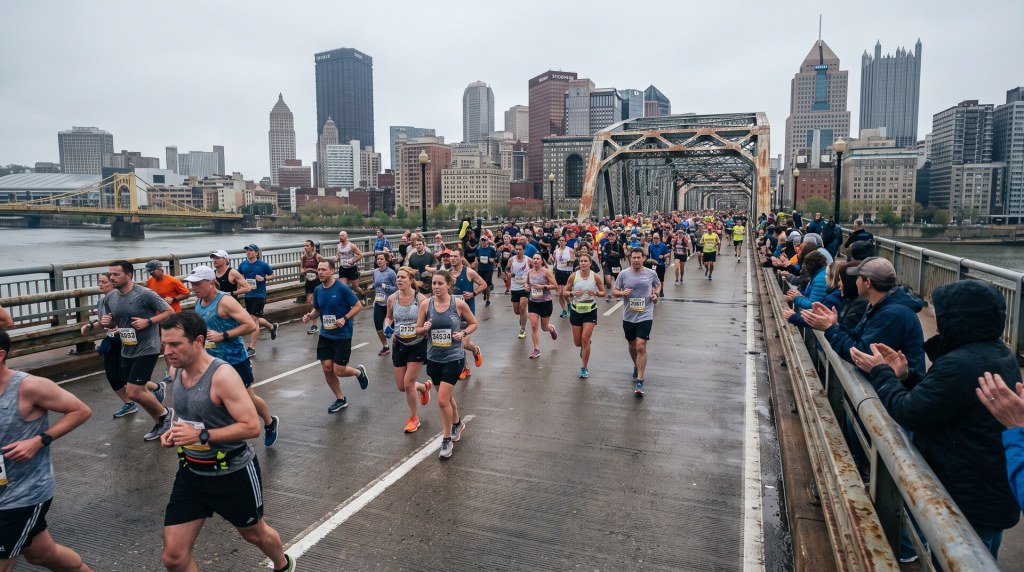
Here’s what those guides leave out, because they’re written by people who flew in for the weekend. That climb sits almost exactly where the half marathoners peel off. Which means two things. You’ve just come off a flat downtown stretch with fresh legs, and the crowd on that bridge is one of the loudest on the entire course. People are screaming at you. There’s music. Somebody’s grandmother has a sign.
I hold my pace through it every year. Not because I’m fast, but because I train hills, and because 173 feet with a crowd yelling at you is a completely different experience than 173 feet alone.
Don’t let the bridge scare you. It’s a long uphill stretch and then it’s over.
What the Course Actually Does to You
The problem with Pittsburgh isn’t one hill. It’s that the climbing never really stops.
My watch logged 939 feet of gain for the full in 2025, which lines up with the 933 feet RunDida has for the course. That number sounds manageable right up until you understand how it’s distributed. It isn’t one wall you climb and then recover from. It’s twenty-six miles of the ground refusing to be flat.
A few specific spots are worth knowing before race morning:
- Miles 1 through 11 are basically net flat, about 16 feet of net gain across the whole stretch. This is where people ruin their race.
- Mile 12 is the Birmingham Bridge climb. Everybody warns you. It’s fine.
- Mile 14 is the high point of the course, around 974 feet of elevation.
- Mile 18 is the second-hardest mile at 43 feet of gain, and it shows up when you have nothing left to give it.
- Mile 22 drops 147 feet, the fastest mile on the course, and it will trash your quads if you let it.
That mile 22 descent is the one I’d underline. After twenty-two miles of climbing, a free downhill feels like a gift, and it’s actually a bill. The finish sits back down at river level in Point State Park, around 738 feet, so everything after mile 22 is you giving back the elevation you spent all morning earning.
The Pittsburgh Marathon Course Tips Nobody Writes Down
Here’s the part I’d have paid for if somebody had told me before 2025.
The second half of the full is the hardest part of the race, and it has almost nothing to do with elevation.
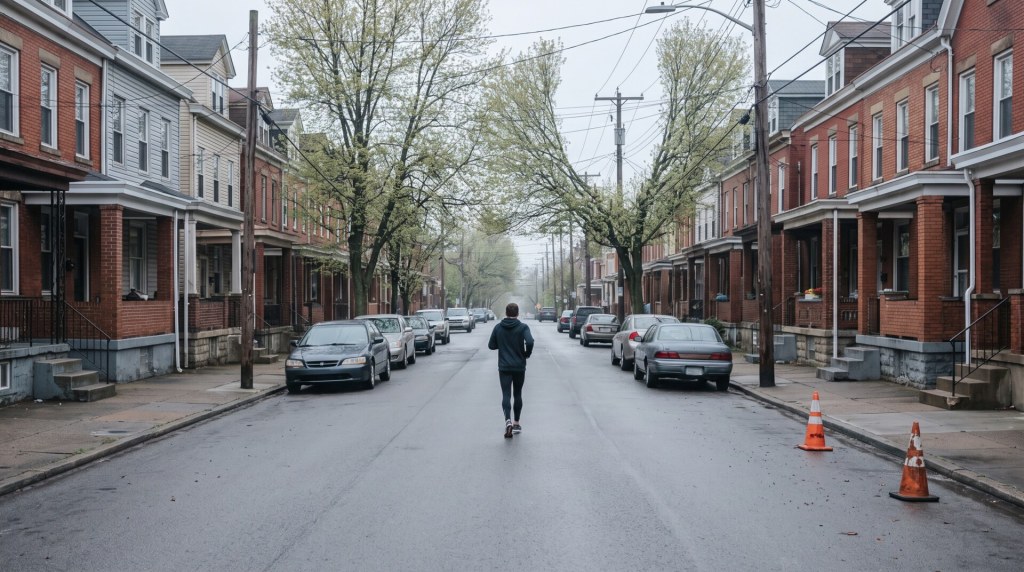
The spectators are front-loaded. Downtown, the bridges, the North Shore, the crowds are enormous and constant. Then you turn into the neighborhoods and it stops. You’re running residential streets in the East End. There’s no skyline. There’s no crowd. There’s a guy on his porch with a coffee who nods at you.
It gets lonely. It gets boring. And “boring” sounds like a soft complaint right up until you’re seven miles out from a finish line you can’t see, with nobody around, and your legs already gone.
Every elevation profile in every guide will show you mile 12. None of them show you mile 17 at 10:30 in the morning when it’s quiet.
What I Actually Do About It
I run the first half without headphones.
That’s on purpose. The crowd through downtown and across the bridges is the best free energy in the race and I’m not drowning it out with a playlist. You get carried through that section whether you want to be or not.
Then right around the halfway point, when the noise drops off, the headphones go in.
That’s it. That’s the whole strategy. It’s stupidly simple and it’s the most useful thing I do on that course. I’ve got seven or eight lonely miles ahead of me and the difference between running them in silence and running them with something in my ears is enormous.
Save it. Don’t burn your audio in the first 5K when you don’t need it. You’ll need it at 16.
How I Train for a Course Like This
I don’t run specific named Pittsburgh hills. People ask me that and the honest answer is boring. I just make sure hills are always in the plan.
The Pittsburgh Marathon has hills, and they’re long ones, so hills are a permanent part of my training instead of a block I bolt on six weeks out. That’s the whole philosophy. If your legs only meet a climb during a dedicated hill workout, race day is the first time they’ll meet twenty of them in a row.
This isn’t a program and it isn’t complicated. It’s a rule. Routes with elevation, most weeks, all year. My weekday runs are 30 to 45 minutes because that’s what I’ve got with three kids and a full-time job, so the hills have to live inside the routes I’m already running rather than get added as extra work. I wrote the longer version of how I fit marathon training around a family already.
The other thing that moved the needle had nothing to do with hills. Adding zone 2 running to my week is what broke a plateau that harder running never touched, and it’s a big part of why my half time dropped.
The Actual Numbers
I’m not a fast runner and I want that on the record before the times show up, because the point here isn’t the numbers, it’s what the course did to them.
The 2025 full: 4:26:48, 26.54 miles on my watch, averaging 10:03 per mile, 939 feet of gain, average heart rate of 170.
The 2026 half: 1:58:55, 13.39 miles, averaging 8:52 per mile, 480 feet of gain, average heart rate of 165. Personal best by 3 minutes and 32 seconds.
Put those two elevation numbers next to each other. The half is barely more than half the distance and it carries roughly half the climbing. Pittsburgh doesn’t hand you an easy opening and then present the bill at the end. It’s hilly the entire way, and the half is a genuinely hard race on its own, not a warmup for the real one.
If you’re staring down your first one of these at any distance, I put everything I got wrong the first time into a separate post.
What I’d Tell You If You’re Running It Next Year
The 2027 race is Sunday, May 2, 2027, with a 7:00 a.m. start. If you’re signed up, here’s three years of learning this course compressed into five things.
Run miles 1 through 11 slower than feels right. That flat stretch is the most dangerous part of the race precisely because it feels great. Every second you bank there gets collected later, with interest.
Stop worrying about the Birmingham Bridge. Respect it, don’t fear it. Shorten your stride, let the crowd do some of the work, and get on with it.
Have a plan for mile 14 onward that isn’t about your legs. Headphones, a mantra, chopping the remaining distance into chunks, whatever works for you. The back half is a mental problem wearing a physical problem’s clothes.
Protect your quads on the mile 22 descent. Free speed at 22 costs you at 25.
And put hills in your training year-round instead of in a six-week panic. Everything else on this list gets easier if you do.
Try This First
Go look at your last four weeks of runs and add up the elevation.
If that number is flat, you’re not training for this course. You’re training for a different race that happens to be the same distance. Pick one route this week with real climbing in it and make it a standing part of your rotation. Not a workout. A route you run all the time.
Do that for a year and the Birmingham Bridge turns back into a bridge.