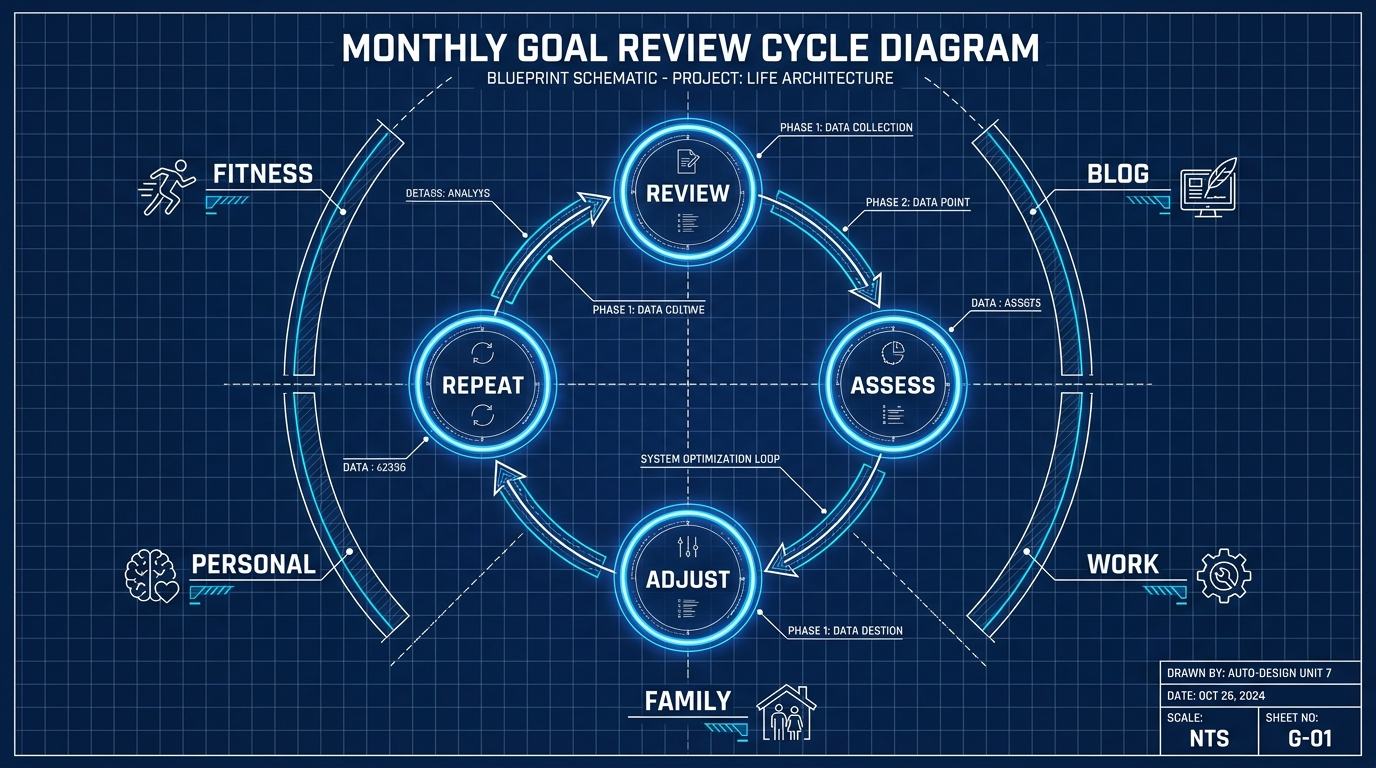
TLDR: I review my yearly goals every month and it takes about fifteen minutes. No dashboard, no color-coded tracker, no elaborate system. Just my notes app and a few honest questions. Simple on purpose, because complicated is what made me stop doing it before.
Why Most Goal Reviews Fall Apart
I’ve tried doing goal reviews the “right” way. Notion dashboards with progress bars. Spreadsheets with formulas that calculated percentage completion. Color-coded quarterly breakdowns that looked great on day one and were completely abandoned by February.
The problem wasn’t motivation. The problem was that maintaining the system became its own job. Every time I sat down to check in on my goals, I was also maintaining the infrastructure around my goals, and that overhead was enough friction to make the whole thing feel like a chore. So I’d skip it. Then skip it again. Then it was June and I hadn’t looked at my goals since January and I felt vaguely bad about that without being able to do anything useful about it.
What I do now is almost embarrassingly simple. And it’s the first version of this habit that has actually stuck.
The Setup
At the start of every year I write my goals for the year in my notes app. That’s it. A single note. No sub-pages, no linked databases, no tags. Just a list of the things I actually want to accomplish or work toward in the next twelve months, written in plain language.
I keep the list short. Usually somewhere between five and eight goals across the categories that matter to me: running and fitness, the blog, work, family, and something personal. If a goal is too vague to know whether I’ve made progress on it, I rewrite it until it isn’t. “Get faster” is not a goal. “Run a sub-4:30 marathon” is a goal. The difference matters when you’re reviewing it eleven months later.
The note stays pinned at the top of my notes app all year. I see it constantly without doing anything. That low-level visibility is doing quiet work in the background.
What the Monthly Review Actually Looks Like

On the last Sunday of every month I open the note. I read through each goal. For each one I ask myself three questions, and I answer them honestly, in my head or in a quick note underneath if something feels worth capturing.
Did I make progress this month? Not did I complete it, not am I on track for some projected timeline. Just: did I move toward this or not. Yes or no. If the answer is yes, I move on. If the answer is no, I go to question two.
Why not, and does it still matter? Sometimes the answer is “I had a hard month and this slipped.” Fine. Sometimes the answer is “I haven’t touched this because I’m not actually that interested in it anymore.” Also fine, but worth knowing. Goals are allowed to change. Life changes. What I wanted in January isn’t always what makes sense in August. If a goal has quietly stopped mattering, I’d rather acknowledge that clearly than carry it as a guilt item for the rest of the year.
What’s one thing I can do next month to move this forward? Just one. Not a plan, not a strategy session. One concrete action. If I can’t name one, the goal is probably too vague and needs to be rewritten.
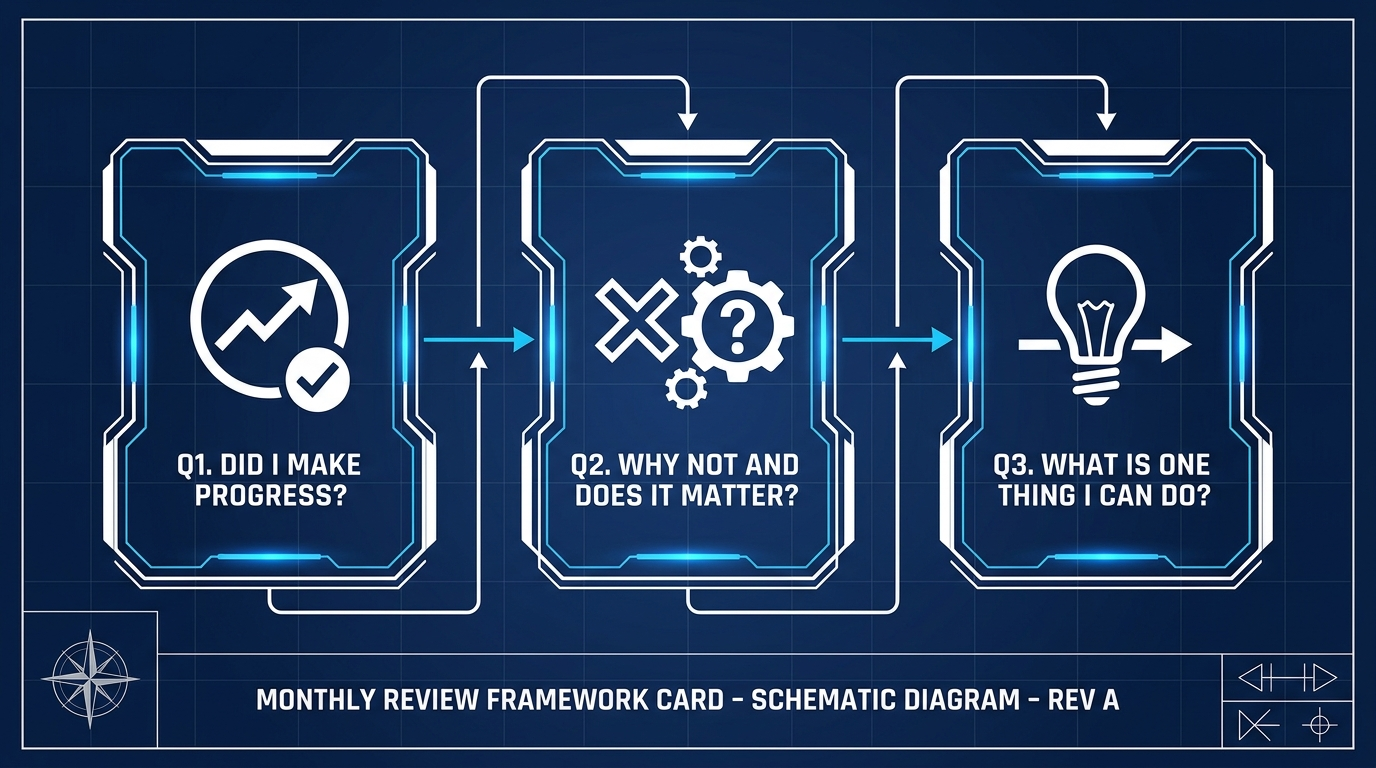
That’s the whole review. Three questions per goal, fifteen minutes total, done.
Why I Do It This Way
I’m a software developer with a full training schedule, three kids, and more hobbies than I have time for. I do not have the bandwidth for a complicated goal tracking system. More importantly, I don’t need one. The point of reviewing goals isn’t to generate beautiful data about how I’m doing. It’s to stay connected to what I said I wanted and make small adjustments before I drift too far off course.
The notes app does that job fine. It’s always there, it’s fast to open, it requires zero maintenance, and it doesn’t nag me with notifications or guilt me with empty progress bars. It’s just a note. The simplicity is the feature.
I also do this on Sunday intentionally. The Sunday routine is already a planning and reflection day for me. Attaching the monthly review to a day I’m already in that headspace means it doesn’t need its own activation energy. It just slides in at the end of the regular Sunday session and gets done.
What Gets in the Way
Honestly, not much anymore. The review is short enough that I’ve never genuinely not had fifteen minutes for it. The main disruption is a packed or unusual end-of-month Sunday, in which case I just do it the following Sunday. Missing by a week doesn’t matter. The goal is roughly monthly contact with the list, not a hard deadline.
The other thing that occasionally gets in the way is a goal that’s been stalled for two or three months in a row. That one starts to carry a little weight every time I get to it. My rule: if something hasn’t moved in three consecutive months and I can’t name a concrete reason why, I either rewrite it into something more actionable or I drop it. Carrying dead weight on a goal list is its own form of overhead. The list should feel like direction, not accusation.
How to Start
Open your notes app right now and write down your goals for the year. Not in a new app, not in a new system, not somewhere you have to set up first. Your notes app. The one already on your phone. Five to eight things, plain language, specific enough that you’ll know in December whether you did them. Pin the note. That’s the setup. The review habit builds from there.
Try This First
At the end of this month, set a fifteen-minute timer, open your goals note, and go through the three questions for each item. That’s the whole thing. If you don’t have a goals note yet, write one first. Either way you’ll be done before the timer goes off, and you’ll feel more oriented about your year than you did before you started.
Take what’s useful. Leave the rest.