

TLDR: I used to try to overhaul my habits all at once and wonder why nothing stuck. Micro-habits fixed that. Small, almost embarrassingly small, actions attached to things I already do. Here’s how I actually run them and why they compound into the big stuff over time.
Why Big Changes Don’t Stick
I have a personality type that goes all in. When I decide I want to do something, I want to do all of it, immediately, at full intensity. This is great for signing up for marathons. It is not great for building sustainable habits.
I’ve started more Monday morning overhauls than I can count. New sleep schedule, new morning routine, new nutrition plan, new training block, all at once. It works for about a week. Then one thing slips, which makes the next thing easier to skip, and by Thursday I’m back to exactly where I started and feeling worse about it than before I tried.
The problem isn’t motivation. Motivation was never the issue. The problem is that big changes require a lot of willpower to initiate every single day, and willpower is not a renewable resource that resets cleanly every morning. It runs out. Life gets in the way. The habit breaks.
Micro-habits are a different bet entirely. You’re not trying to overpower the friction. You’re trying to remove it.
What a Micro-Habit Actually Is
A micro-habit is a version of the behavior you want that’s so small it’s almost impossible to say you don’t have time for it. Not “go to the gym” but “put your gym shoes on.” Not “read more” but “read one page.” Not “meditate” but “take three deep breaths before getting out of bed.”
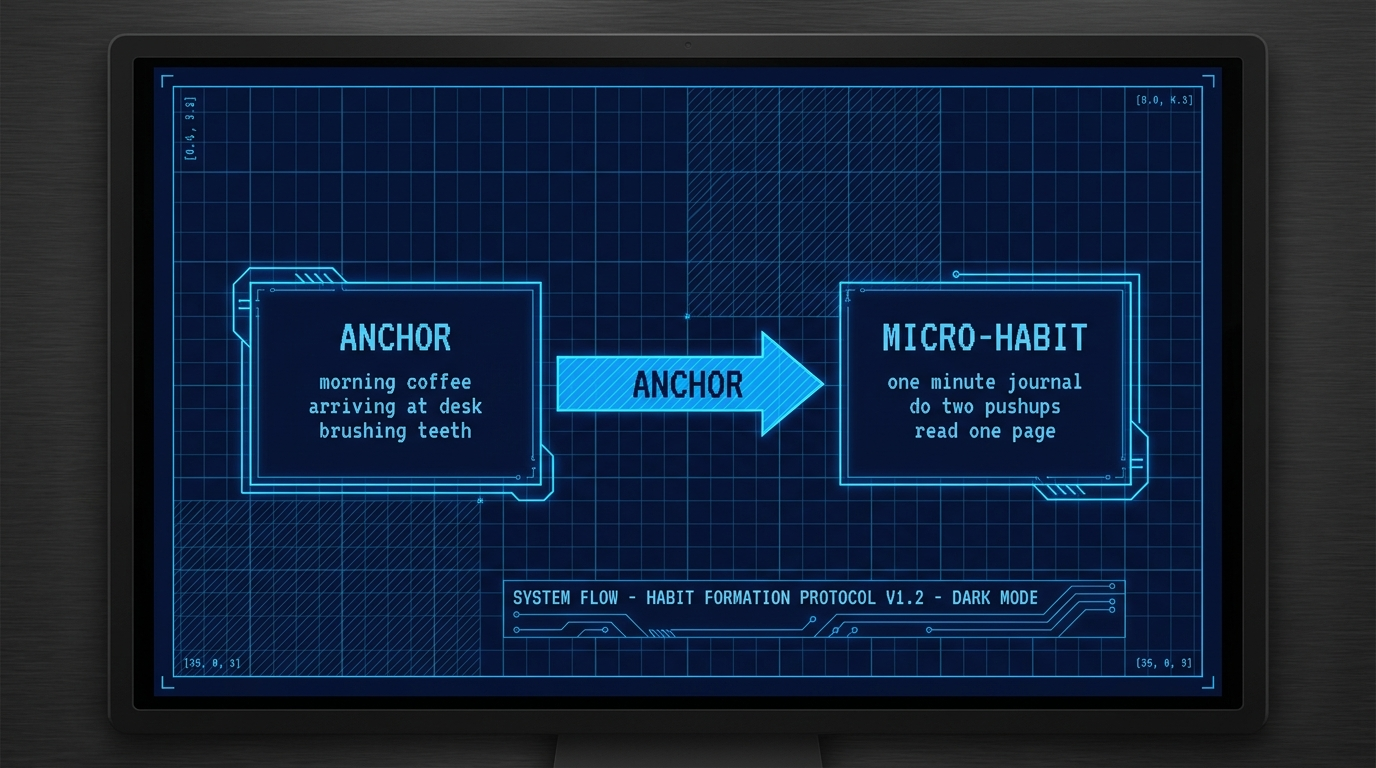
The size is the point. You’re not scaling down your ambition. You’re scaling down the entry cost of the behavior until it’s basically zero. And then you attach it to something you already do every day without thinking, what habit researchers call a trigger or anchor. The existing habit cues the new one automatically.
That’s the whole mechanism. Small action, attached to an existing anchor, done consistently. The compounding happens on its own.
What My Micro-Habits Actually Look Like
I’m a marathon runner, a dad of three, a developer, and someone with more hobbies than hours. My weeks are not predictable. What works for me has to be anchored to things that happen regardless of how chaotic the day gets.
Here’s what I’m currently running:
After I pour my morning coffee: one minute of journaling. Not a full journal entry. One minute. I write whatever’s on my mind, or I write nothing and just sit with it. The coffee triggers it. I have not missed a morning since I attached it to the coffee because I have never missed a morning coffee.
Before I open my laptop for work: write down my three priorities for the day. Three things. On a sticky note. Takes forty-five seconds. It doesn’t always go to plan, but I start every day knowing what actually matters instead of just reacting to whatever shows up first.
After every run: one mobility exercise. Just one. Hip flexor stretch, pigeon pose, couch stretch, whatever my body is asking for. I’m already sweaty and on the floor cooling down. The friction is zero. Over the course of a training block this adds up to more consistent mobility work than any dedicated stretching routine I’ve ever tried to build separately.
When I sit down to watch TV at night: drink a full glass of water first. I’m terrible at hydrating in the evenings. Attaching it to a guaranteed nightly event means it actually happens. It’s not a hydration habit, it’s a TV habit with water in front of it.
Before bed: lay out tomorrow’s gym clothes. If my gym clothes are already out, I go to the gym. If they’re not, I negotiate with myself and lose. This one single habit has done more for my training consistency than any motivational framework I’ve ever tried.
Why I Do It This Way
I have three daughters and a job and a training schedule and a blog and a list of hobbies that my wife tolerates with impressive patience. I do not have reliable blocks of free time where I can execute a twelve-step morning routine. What I do have are the small reliable moments that exist in every day regardless of how much else is going on.
Micro-habits live in those moments. They don’t compete with the chaos. They’re already done before the chaos starts.

The other thing: they scale naturally. Once a micro-habit is automatic, you barely notice you’re doing it. At that point you can expand it slightly, or add a new one next to it, or just leave it as is and let it keep doing its quiet work. You never have to white-knuckle it through day one again because day one was easy enough that you actually did it.
What Gets in the Way
Travel. That’s the main one. When I’m out of my normal environment, all the anchors change. No morning coffee ritual because I’m in a hotel. No nightly TV routine because schedules are different. The micro-habits that are attached to home-based triggers just don’t fire.
What I’ve figured out is that you need travel-specific anchors for the habits that matter most. My one rule on the road: before I leave the hotel room in the morning, I do five minutes of something physical. Doesn’t matter what. That’s the anchor and the habit combined. It’s not elegant but it keeps the thread alive until I’m back in my normal environment.
The other disruption is a genuinely hard week. Sick kid, work blowup, long run that wrecks me for two days. Some micro-habits don’t survive those weeks and that’s fine. The goal is not a perfect streak. The goal is that the habit is easy enough to restart that you actually do it when things normalize, instead of treating a missed day as a reason to quit entirely.
How to Start
Pick one thing you keep failing to build as a habit. Just one. Now make it smaller. Smaller than that. Keep going until it’s so small that the only legitimate excuse not to do it is that you’re physically incapable. Then find one thing you already do every day without thinking and attach the new habit immediately after it. Do that for two weeks before you add anything else.
That’s it. Stupidly simple. Which is the whole point.
Try This First
Tonight, before you go to bed, lay out tomorrow’s workout clothes. That’s it. That’s the whole assignment. See what happens when the friction is already gone before the alarm goes off.
Take what’s useful. Leave the rest.