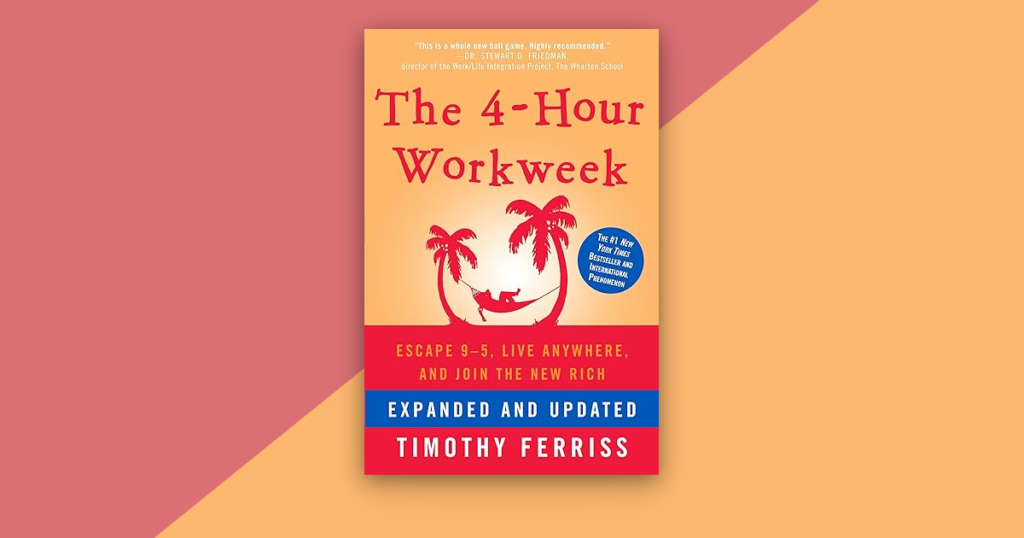
TLDR: The 4-Hour Workweek is Tim Ferriss’s bestselling playbook for escaping the 9–5 grind and designing a life on your terms. Part productivity guide, part automation manual, part lifestyle manifesto — the book challenges conventional definitions of success and offers tactics to work less and live more. Not everything in it has aged well, but the core philosophy still resonates.
- Title: The 4-Hour Workweek
- Author: Tim Ferriss
- Format Consumed: Audiobook and print
- Length: ~13 hrs (416 pages in print)
- Genre: Business / Productivity / Lifestyle Design
- Rating: ⭐️⭐️⭐️⭐️

I read this book because I kept hearing it cited by entrepreneurs, creators, and digital nomads — people building alternative careers outside the corporate world. As someone constantly evaluating how I spend my time and what “freedom” really means, this felt like a necessary read.
Right away, I could see why it’s polarizing. Ferriss is bold, a little arrogant, and extremely tactical. But he also makes you stop and question everything you’ve accepted about work, productivity, and time. The biggest win for me wasn’t the exact tools he shared — some of them feel dated — but the mindset shift: optimize your life for output, not hours.
If you’re looking for a practical guide to ditching the 40+ hour workweek, this book is foundational. Even if you don’t want to move to Thailand or build a drop-shipping empire, the principles are powerful.
The Lowdown On The 4-Hour Workweek
Ferriss divides the book into four sections, based on his DEAL framework: Definition, Elimination, Automation, and Liberation. The idea is simple: define what you want out of life, eliminate what doesn’t matter, automate what you can, and liberate yourself from physical location and fixed schedules.
He mixes personal stories, case studies, and actionable tools — everything from email templates to outsourcing workflows to setting up passive income. The tone is confident and fast-paced, sometimes bordering on cocky, but that’s part of what makes the material engaging.
This isn’t a philosophical deep-dive. It’s a tactical, execution-heavy manual for creating time and mobility.
How Easy Is The 4-Hour Workweek To Read?
It’s very accessible. Ferriss writes like he talks — blunt, practical, and full of sidebars and listicles. You can skim it for tools or read it front to back for the full mindset shift.
Some sections feel like they were written in the golden age of 2000s internet business, so a few tactics (especially around automation and VA outsourcing) need to be updated or researched further. But the overall reading experience is fast and engaging.
Whether you’re a corporate employee, solo creator, or small business owner, this book is easy to digest and apply.
My 3 Biggest Takeaways From The 4-Hour Workweek
1. Time is a currency — spend it like money
This mindset shift hit hard. Instead of thinking, “How do I make more money?” Ferriss challenges you to ask, “How do I get more time?” He treats time as the real metric of wealth, and it reframes everything from career choices to daily habits.
“The opposite of happiness is boredom.”
2. Being busy is a form of laziness
Ferriss doesn’t glorify hustle. He sees constant busyness as a failure to prioritize. This made me rethink how much of my daily effort is just noise — tasks that feel productive but don’t move the needle.
“Being busy is most often used as a guise for avoiding the few critically important but uncomfortable actions.”
3. You can build systems that work without you
The automation sections were full of concrete strategies — even if not all are plug-and-play today. The broader lesson is powerful: you can create systems that earn, respond, and operate while you’re off the clock. That’s where real freedom starts.
“Work wherever and whenever you want, but get your work done.”
Final Thoughts
The 4-Hour Workweek isn’t perfect. Some of its tactics feel dated, and Ferriss’s tone won’t be for everyone. But the mindset behind it — questioning norms, optimizing for freedom, and designing a life around what matters — is timeless.
This is one of those rare books that shifts how you think, not just what you do. If you’ve ever wanted out of the grind or felt like you’re building someone else’s dream, read it. Then read it again.