

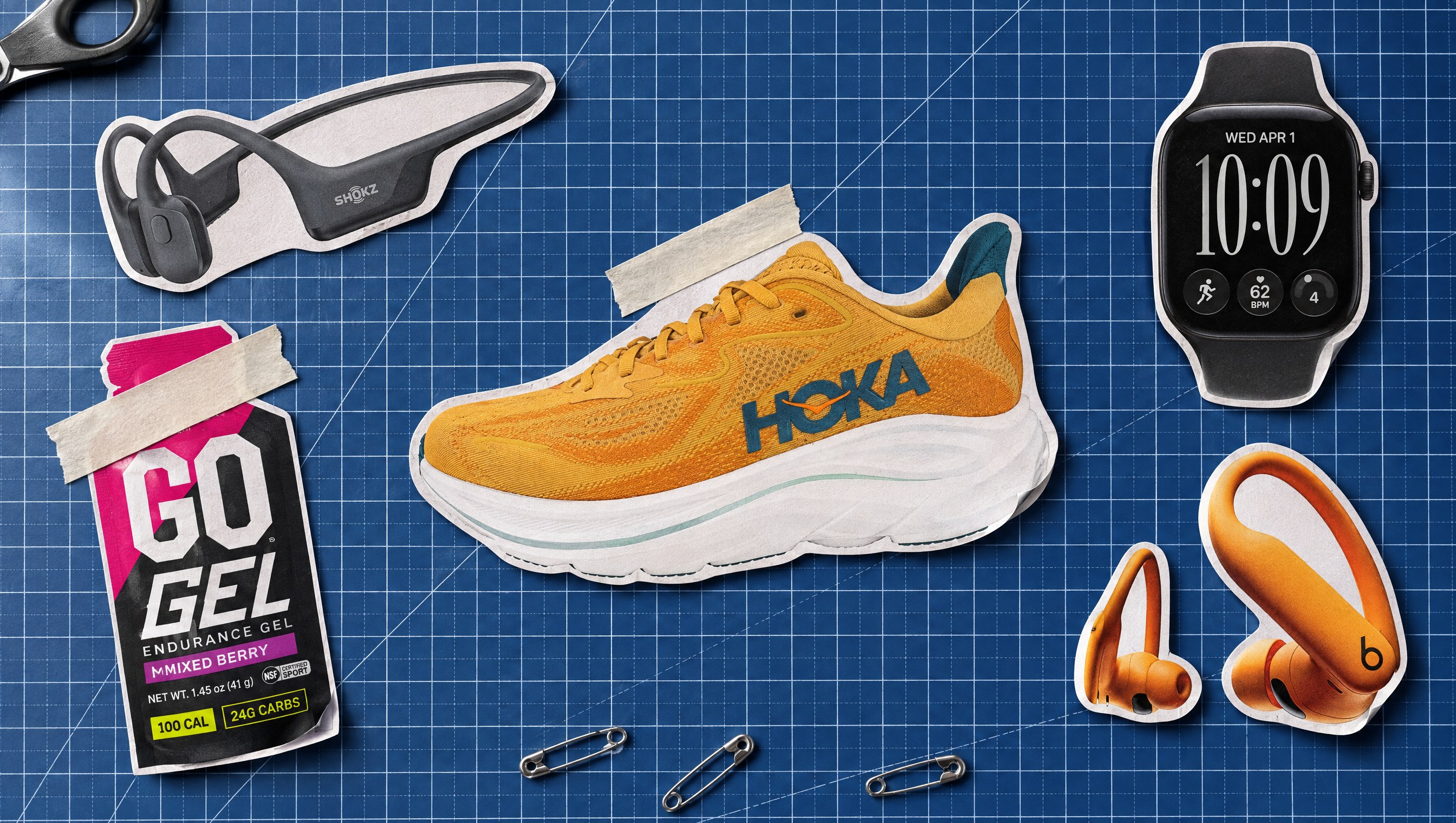
TLDR: My running essentials are short. Hoka Clifton 10s, an Apple Watch, Shokz for outdoor runs and Powerbeats Pro on the treadmill, BPN Go Gels stuffed in the pockets of my tights, and two SparkO clip lights for 5am runs in the dark. That’s the whole kit I train and race marathons in. I bought a running belt, an armband, a hydration vest, a handheld bottle and compression gear, and I stopped using every one of them. If you’re just starting, buy shoes that fit and tights with pockets before you buy anything else.
Every running essentials list I’ve read is a shopping cart with a byline. Forty accessories, all of them “must haves,” and somehow nobody admits they bought half of it and quit using it.
I have. I’ve run the Pittsburgh Marathon weekend three years in a row, a full and two halves, and most of my running happens at 5am in the dark. What I take out the door now fits in one hand. Here’s all of it, what each piece does well, where it falls short, and the gear I paid for and put in a drawer.
Why Most Running Essentials Lists Don’t Help
The top results for this search are store checklists and giant accessory roundups. They aren’t wrong, exactly. A store has every reason to tell you that you need a vest, a belt, arm sleeves and a massage gun. What they skip is the only part that matters: which of these you’ll use on a 30 minute Tuesday run, and which ones you’ll use twice.
My filter is stupidly simple. If it doesn’t make a weekday run easier or safer, or get me through the weekend long run, it doesn’t make the list. Everything below is gear I actually use right now. Everything in the last section is gear I bought and stopped using.
My Running Essentials: The Short List
Six things. Shoes, a watch, headphones, fuel, tights with pockets and a light. That’s the whole kit, and here’s why each one earned its spot.
| Essential | What I use | What it’s for |
|---|---|---|
| Shoes | Hoka Clifton 10 | Every run, every race |
| Watch | Apple Watch | Heart rate zones and logging |
| Headphones | Shokz | Outdoor runs, so I hear traffic |
| Headphones | Powerbeats Pro | Treadmill runs, for the sound |
| Fuel | BPN Go Gels | Carbs on the run |
| Tights | Under Armour, Gymshark, WOLACO | Pockets that carry the gels |
| Light | SparkO, two of them | Front and back on dark runs |
1. Running Shoes: Hoka Clifton 10

It took me two years and seven pairs to land on the Hoka Clifton 10. Two pairs of Under Armour were too narrow and hurt my feet on long runs. The Nike Pegasus lost its tread fast. Two pairs of Brooks were fine but felt like too much shoe. I tried the Hoka Bondi once and went right back to the Clifton.
Now I run one pair of standard width Cliftons for a whole season. I train in them, race marathons in them, and retire them after the big race unless something goes wrong first. I don’t track the miles on them. When the season’s over, so are they.
The catch: that’s my foot, not yours. The real lesson from seven pairs is to get fitted and stop buying shoes because a list told you to. I wrote up every pair and why it failed in the seven running shoes I tried before the Clifton.
2. GPS Watch: Apple Watch
I train by heart rate zones, and the Apple Watch is how I know which one I’m in. Mid run, I glance at the zone on screen and speed up or back off. My zone 2 sits around a 9 minute mile, but hills, heat, food and water all move that a lot. I also wore it for over a month of INTVL, a territory running game, and my INTVL app review covers why I quit.
What it does well is everything outside the run. It’s already on my wrist all day, every run lands in Apple Health, and that data feeds the AI running coach I built with Claude. No syncing, no second app to babysit.
Where it falls short: wrist heart rate isn’t a chest strap. I treat the zone reading as good enough, not exact. If you need lab precision, this isn’t your watch. I don’t, so it’s mine.
3. Headphones: Shokz Outside, Powerbeats Pro on the Treadmill

Yes, two pairs. It isn’t greed. It’s safety versus sound.
Outside at 5am, I’m sharing dark roads with drivers who haven’t had their coffee yet. Shokz are bone conduction headphones. They sit in front of your ears instead of in them, so I hear my audiobook and the car coming up behind me at the same time.
When it gets cold, my runs move to the treadmill in the garage, and there’s nothing out there to listen for except the motor. That’s when the Powerbeats Pro come out. They sound better and they block out the noise.
Race day has its own rule: no headphones for the first half of a marathon. The crowds are the best part of the race. They go in for the lonely second half.
The trade off is real. Shokz don’t sound as good as earbuds, and two pairs means two things to charge. For me, hearing traffic in the dark is worth both. The third pair I use, for everything that isn’t a run, is in my gift guide for Kindle and audiobook lovers.
4. Fuel: BPN Go Gels

My fuel is Bare Performance Nutrition Go Gels. Each pack has 24 grams of carbs and 100 calories, and BPN makes a caffeinated version too. I have no complaints. They go down, they do their job, and I don’t think about them again until the next one.
That’s the whole fuel setup. No bottle, no flask, no electrolyte system. I don’t carry water on training runs at all, which I’ll defend in a minute.
5. Tights With Pockets: Under Armour, Gymshark and WOLACO
This is the one nobody puts on their running gear list, and it’s the reason my running belt is retired. My gels ride in the pockets of my tights. Nothing bouncing on my waist, nothing strapped to my arm.
My drawer is a mix of Under Armour, Gymshark and WOLACO. I don’t have a favorite brand. I care about one thing: a pocket that holds a gel. If a pair of tights has that, it’s in the rotation.
6. Light: Two SparkO Clip Lights
Run at 5am and you spend half the year running in the dark. The SparkO by ScoutLite is a small magnetic wearable light, 300 lumens and about 40 grams, so you forget it’s there.
I clip two of them to my waistband, one in the front and one in the back. The front one lights the road. The back one is for the drivers coming up behind me.
Running Essentials I Bought and Stopped Using
Here’s the section the store checklists will never write. I bought every one of these because a list said I needed it. All of them are in a drawer now.
Running Belt and Armband
Tights with pockets killed both. Once the gels had somewhere to go, I didn’t need either one. Moving on.
Hydration Vest and Handheld Bottle
Both were annoying to carry, and it turns out I’m fine without water on training runs. When I train for a half, my long runs top out at 12 miles, and I run every one of them empty handed.
Compression Gear
I wore it and felt no difference. Maybe it works for you. It did nothing for me, so it stays in the drawer.
Who This Running Gear Is For (and Who It’s Not)
This kit is built for one kind of runner, and I’d rather you know that up front than buy the wrong stuff.
- It’s for road runners training for a half or a full, especially if your weekday runs are short and your long run is on the weekend.
- It’s for early morning runners. If you run in the dark, the lights and the open ear headphones matter more than anything else here.
- It’s for beginners who want to spend money in the right order: shoes that fit, tights with pockets, a light if it’s dark. The rest can wait.
- It’s not for trail or ultra runners. You’re far from help and you need water, and probably the vest I gave up on.
- It’s not for anyone who needs exact heart rate data. Get a chest strap.
Try This First
Before you buy another piece of running gear, get fitted for shoes. Then run for a month with nothing but those shoes, whatever tracks your run, and a pocket. Whatever you actually miss on those runs is your next purchase. Whatever you don’t miss, you just saved money on.
And if that month is building toward a race, read what to know before your first half marathon next. Take what’s useful. Leave the rest in the drawer.


